

You wake up, and you’re already behind.
The meditation, the morning light, the cold protocol – they were supposed to be done by now. You drag yourself from bed to bathroom, and the run window is already shrinking. Then you remember last week’s LinkedIn post: exercise and nutrition barely matter if your sleep is broken. You check the wearable. Sleep score: Okay. In wellness-speak, Okay means shit.
You’ve always been the ambitious one. Career, family, the holiday plans, the projects that quietly become yours – you don’t do average. Now health is the new game, and others seem to be winning at it. You feel the urge to catch up. After all, isn’t your health the one thing that actually matters more than anything else? So you push harder.
I push harder. I run a lot. My VO2 max stays in the upper 50s. And then my GP tells me my blood pressure is too high. What the fuck? Am I still missing something? Should I be doing more?
I start reading about habits. Which really means I start reading about what other people do every day. I add one thing that sounds useful. Then another. Suddenly I have a list of twenty. The list grows. I see it every morning and feel like I’m failing. So I stop looking. I hide the list. The harder I try not to think about it, the more clearly I know I’m doing something wrong. I feel trapped.
How did I get here?
Scoreboard culture and optimization craze
Longevity has gone mainstream. Bestsellers like Outlive (Attia, 2023) and Lifespan (Sinclair, 2019) reach millions of readers. Podcasts brought biomarkers into dinner-table conversation. Wearables put a live score on your wrist. What used to be the doctor’s job is now a 24/7 personal project.
For ambitious, high-performing people, this lands on familiar ground. The same self-made strategy that built the career gets applied to the body. Health becomes another thing to win at. And because your watch can quantify almost anything, the temptation to chase a target is constant.
Habits sit at the centre of this story. Books like The Power of Habit (Duhigg, 2012) and Atomic Habits (Clear, 2018) turned what had been a fairly technical area of behavioural science into the most-read self-improvement category of the last decade. The underlying insight is real: small actions, repeated in context, reshape who you become and drive lasting change. Habits work.
The cultural translation has been less careful. The same approach that helps someone quit smoking gets stacked, gamified, and turned into a “perfect-day” project. This pattern has a name. Orthorexia (Bratman, 1997) was originally coined for an obsessive preoccupation with healthy eating; similar patterns now extend to fitness, sleep, and the broader self-optimization project. Research on self-tracking technologies (Lupton, 2016) describes a feedback loop where measurement raises anxiety, which raises monitoring, which raises anxiety.
The physiology backs this up. Chronic low-grade stress – the kind generated by always-on self-monitoring and a packed schedule – raises allostatic load (McEwen, 1998), which is independently linked with worse cardiovascular outcomes, poorer sleep, and cognitive decline. The race to be healthier carries its own health cost.
We end up with a paradox: The tool is good and the science behind it is solid. The cultural application is what’s failing us. To use habits well, we have to clear out what we think we know about them.
Misconceptions about healthy habits
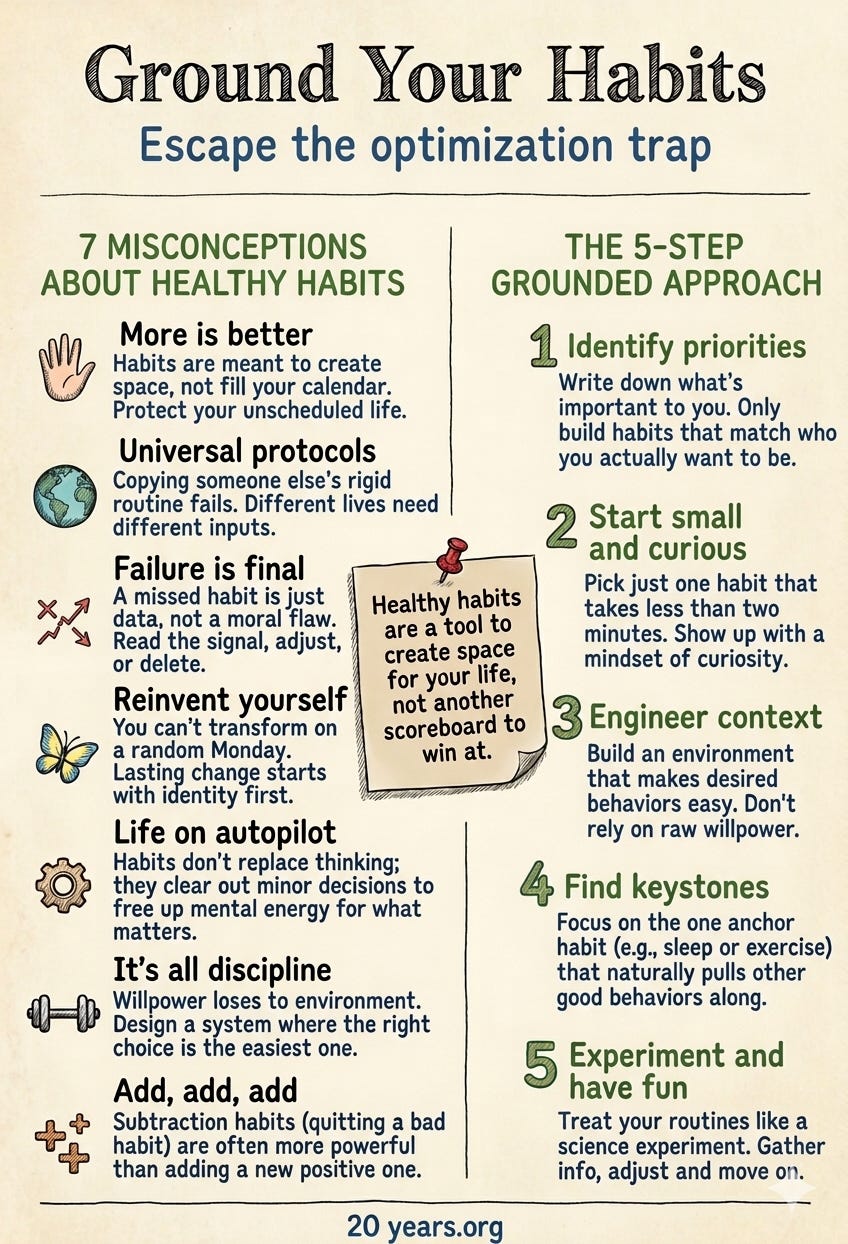
I keep running into the same set of wrong assumptions about habits, in myself, in coaching conversations, and in the longevity content I read every day. Here are the seven that do the most damage:
1. More is better.
Every minute is a resource. Free time should be put to work. If three habits feel useful, surely seven will be better. Why not ten? The day fills up with things you should be doing.
Habits are for creating space. When you automate one behaviour, the time and attention you free up is supposed to go to the parts of life that actually need your presence: the work, the people, the thinking, the recovery. Re-filling it with the next habit on the queue defeats the purpose.
Stacking is also the most common reason habit projects fail. Each new behaviour needs repetition in a stable context to become automatic. Trying to embed five new habits at once divides attention and means none of them gets enough of either. And the cognitive load of managing many simultaneous habits can itself become a stressor: the body reads relentless self-monitoring as low-grade threat, which raises cortisol and undermines the recovery the habits were supposed to support.
Start with one habit. Pick something small enough that doing it is almost effortless. Let it become automatic before you add the next. Aim for a small set of habits that quietly hold the day together, with plenty of unscheduled life around them.
2. I need to find the perfect protocol.
The Instagram version: meditation, cold plunge, fasted cardio, ten thousand steps, magnesium, no phone in bed, gratitude journal, eight glasses of water. Or the lifestyle blueprint copied straight from someone you admire – their morning routine, their evening routine, the protocol they swear by. Either way, the assumption is the same: the right set of habits exists out there, you just need to find it and execute.
This fails in two places: First, there cannot be a universal list for everyone. What works for a 26-year-old single founder in California will wreck a 42-year-old parent of two in Berlin who runs a company and travels twice a month (different sleep patterns, different stressors, different baseline). Different lives need different inputs.
Second, a habit stack isn’t a static template you build once and execute against forever. It’s dynamic by its nature, and it changes continuously. The habit that grounds you this month may become rote in two months and irrelevant in six. Some habits get easier and migrate from conscious effort into the background – you don’t track brushing your teeth anymore, you just do it. Others stop fitting because your life shifted: a new job, a new baby, a slower body, a different season. Some need replacing because they got boring. Others were never right for you in the first place (it can take time to figure that out). This is how habits actually live.
Treat your habit stack as a living thing and pay attention continuously. When something starts running on its own, let it slip into the background and stop tracking it. When something stops fitting, change it or drop it. Build gradually: try things, keep what works, add complementary pieces as gaps appear. There is no perfect day-one plan – the plan is supposed to evolve.
3. Not sticking to a habit means I’m failing.
You missed three runs this week. You broke the meditation streak on day eight. The journal sat empty since Tuesday. The internal verdict: I’m weak, I lack discipline, I’m not the kind of person who does this. (Or at least that’s the voice in my head on Friday morning.)
A missed habit is information. The instinct to read it as moral failure cuts the feedback loop: you stop tracking honestly, hide the list, and the underlying problem drifts unaddressed. The miss is telling you something specific. The habit is too big. The trigger isn’t there. The context isn’t built. Or you don’t actually want it.
Read the signal and adjust. Make the habit smaller, move the trigger, change the environment, or take it off the list. The most useful thing you can do with your list most weeks is delete from it.
4. I can reinvent myself with a new habit stack.
The transformation Tuesday myth: You read a book, get inspired, and decide to turn your life around. From now on I’m a 5am meditator, a daily writer, a cold plunger, a sober vegan. New life starts on Monday.
Habits work the other way around. Durable behaviour change comes from identity first, habits second. The habits you actually sustain are the ones that already fit who you are, or who you’re slowly becoming.
The good news is that you almost certainly already have a lot of behaviours that align with who you want to be. We are naturally consistent in personality, in values, in how we live. Habits don’t have to be built from scratch on a Monday morning – most of what matters is already in you. The work is to notice it, listen to it, and strengthen it.
Start by listening. What’s actually important to you? What kind of person do you already mostly are, and how could you be a little more of that? From there, build incrementally. Add one small habit that strengthens a direction you already lean. Let it stick. Then maybe another. Over years, this compounds into who you become. There is no Monday version of this – only the slow, gradual one.
What I find encouraging: you really can use habits to build the identity you aspire to, the version of yourself who is more focused, more present, more healthy, more whatever-matters-most-to-you. The change happens through what you choose to do every day, until at some point you look back and realise you became someone different.
5. Habits are life on autopilot.
The fantasy: automate everything – food, sleep, exercise, hydration, even some of your relationships – so the mind never has to engage with anything difficult. Set it all on autopilot.
Habits do free up mental space, but not by removing thinking from your life. The point is the opposite: habits take the routine, mechanical decisions off the table (when to eat, what to wear, what time to sleep), so your attention is available for what actually deserves it. The ideal day is a few quiet habits running on their own in the background, and then a wide open canvas of time and mental energy for what actually matters: the work, the writing, the conversations, the family time, the thinking. The autopilot handles the inputs that don’t deserve your focus. You spend yours on the ones that do.
The trap is making the habit system itself the thing that absorbs your attention. The hours saved on choosing breakfast get spent reading about better breakfasts. The mental space freed by automating exercise gets re-filled with tracking, tweaking, and optimising the system. Over-tracking is the most common version of this: once a habit is running on its own, you don’t need to track it. Tracking the things you’d do anyway turns them back into work you have to monitor, which is exactly what habits were supposed to remove.
Aim for an empty canvas. Let the basics run quietly in the background, and protect the unscheduled space that habits create. If you find yourself spending more time managing the habit system than living in the space it opens up, simplify the system.
6. I need more discipline to keep up.
5am alarms. White-knuckle Mondays. The grit narrative. Get up, push through, become elite.
The research tells a more encouraging story: People who look like they have great willpower usually just have great systems. They’ve built routines and environments that make the right choices easy, so they don’t need heroic discipline in the first place. Sticking to habits is much more a function of a good, conducive system than of how strong-willed you are.
Anna Lembke explains the mechanism in her bestseller Dopamine Nation (2021): The brain is wired to chase dopamine, the neurotransmitter of reward and motivation. The dopamine spike actually comes from the cue, not the reward itself. Every time you see chips on the counter, your phone on the bedside table, or a notification on your laptop, your reward system fires in anticipation. That’s what drives craving. And once a cue is in your environment, willpower has to compete with it every single time.
So design the environment first. Make the habits you want easy and visible: water bottle on the desk, running gear out the night before, vegetables pre-chopped at eye level in the fridge, a bowl of almonds on the table instead of cookies. Make the habits you don’t want harder or invisible: junk food in opaque containers on high shelves (or simply not in the house), distracting apps deleted or buried, the phone out of the bedroom. The point is to tilt the environment in your favour so that the choice you want to make is also the path of least resistance. The willpower question solves itself.
7. Habits are about adding things to my life.
When most people think about habits, they think additions. Add a meditation. Add a workout. Add a journaling practice. The list grows in one direction only.
The most powerful habits are often subtractions: not drinking on weeknights, not checking the phone before 9am, not eating after 8pm, not snoozing the alarm. As Michael Easter puts it, much of what’s wrong with modern life is excess (food, stimulation, noise, screens, decisions), not scarcity. The behavioural science of habit formation applies the same way to stopping behaviours as to starting them: cue, context, identity, repetition. And subtraction habits are often easier to sustain – there’s nothing new to remember, just something to skip.
Before adding another habit, ask what you could subtract. Removing one drag – poor sleep, late screen time, sugar at 4pm – often makes more difference than adding three new positives.
The grounded approach to habits & longevity
Yes, lifestyle is essential for your health and you shouldn’t ignore it. And yes, consistent daily routines offer the best chance to achieve lasting improvements that give you a long healthy life full of joy and opportunity.
But you don’t have to go crazy and follow every wellness fad you encounter in your Instagram feed. Or more directly: You absolutely should not. Because otherwise you will never achieve anything sustainable: you trade in short-lived optimization attempts for mental stress. Not a good deal – and not necessary.
Admittedly, it also took me a while to figure that out. For me, habit-based change works best through a few simple steps:
Step 1: Think about your priorities.
Life forces you to prioritize – you can’t pursue everything at once. The same applies to habits: you’ll only stick to the ones that match what’s actually important to you. So answer that question first: What is actually important to me? Who do I want to be? Take fifteen minutes and write down whatever comes up. Your answers give you a basis for choosing which habits are worth building and which are just noise.
Step 2: Start small and curious.
Start by picking one habit, small enough that doing it is almost effortless. James Clear’s two-minute rule is a useful guide: the habit should take less than two minutes to begin, and the only goal at first is to show up. And make sure the habit actually interests you – something you’d be proud to do, or something you admire in others. The habits that stick are the ones you approach with a bit of curiosity and a sense of adventure.
Step 3: Build the context, not the discipline.
The most reliable way to stick to a habit is to engineer the environment around it. Put the running shoes by the door. Move the phone out of the bedroom. Lay tomorrow’s clothes out tonight. When the behaviour you want is also the easiest one, your future self quietly does the work, and your willpower has much less to compete with.
Step 4: Find your keystones.
Some habits matter more than others. Charles Duhigg coined the term keystone habit in The Power of Habit (Duhigg, 2012): a habit that anchors the rest of your day and pulls other good behaviours along with it. For some people that’s daily exercise. For others, consistent sleep or a morning meditation. The keystone habit has an outsized impact on everything else – when you do it well, the other habits get easier and the bad ones lose their grip. Find yours, treat it as essential, and let everything else be the cherry on top.
Step 5: Have fun experimenting.
Habits should be fun. Treat them as experiments – you’re a scientist on your own lifestyle, and your own behaviour is an interesting, modifiable variable. You don’t have to become the next Charles Duhigg, but you can become an innovator about how you live. This mindset matters because it makes the whole project lighter and more sustainable, and it also reframes failure. When a habit doesn’t stick, you’ve gathered information: the habit is too big, the trigger is wrong, the context is missing, or you don’t actually want it. Read the signal and adjust. Missed habits are useful data, not moral failure.
These steps are the foundation of the 20 Years Method – an evidence-based approach to healthy aging across seven dimensions: exercise, nutrition, sleep, mental health, social connection, environment, and regular checkups. The method helps you move from knowing what’s healthy to actually doing it, through habits you can sustain over the long run (see also my earlier piece on five evidence-based strategies: Building Habits That Stick). If you want more guidance on building healthy habits without getting stressed, subscribe to this Substack.
If you’d like to work on this with support, either one-on-one or through our Longevity Booster program, message me directly on LinkedIn. I’ll also share more details in a separate post soon. If you feel like trying out by yourself, the Habit Builder app (early beta) is a great guide to exploring and building longevity habits. You can also use it to track progress together with friends: Social accountability is one of the strongest drivers of habit success.
HABIT BUILDER – Get the app for free.
The 20 Years Habit Builder app is now in early beta. It’s still a web app (native app coming soon), but it already puts the steps above directly into your phone. You can use it for free and your feedback at this stage genuinely shapes where it goes next – so try it out and tell me what works and what doesn’t.
Here’s how to install it:
📱 iPhone: Open app.20years.org in Safari → tap the Share icon (top or bottom of the screen) → tap “Add to Home Screen” → “Add”. Done!
🤖 Android: Open app.20years.org in Chrome → tap the three dots in the top right → tap “Add to Home Screen” → “Add”. Done!
The app will appear on your home screen (like any other app). Let me know what you think. 🙏
SPECIAL THANK YOU to our early testers: If you make an account now and add your first habit, the app will stay free forever for you.
References
Attia, P. (2023): Outlive: The Science and Art of Longevity. Harmony. peterattiamd.com
Bratman, S. (1997): Health Food Junkie. Yoga Journal, October issue. orthorexia.com
Clear, J. (2018): Atomic Habits: An Easy & Proven Way to Build Good Habits & Break Bad Ones. Avery. jamesclear.com
Duhigg, C. (2012): The Power of Habit: Why We Do What We Do in Life and Business. Random House.
Easter, M. (2023): Scarcity Brain: Fix Your Craving Mindset and Rewire Your Habits to Thrive with Enough. Rodale Books. eastermichael.com
Fogg, B.J. (2020): Tiny Habits: The Small Changes That Change Everything. Mariner Books. tinyhabits.com
Lembke, A. (2021): Dopamine Nation: Finding Balance in the Age of Indulgence. Dutton.
Lupton, D. (2016): The Quantified Self: A Sociology of Self-Tracking. Polity Press. politybooks.com
McEwen, B.S. (1998): Stress, adaptation, and disease: Allostasis and allostatic load. Annals of the New York Academy of Sciences, 840, 33–44. pubmed.ncbi.nlm.nih.gov/9629234
Sinclair, D. (2019): Lifespan: Why We Age — and Why We Don’t Have To. Atria Books.
Wood, W. (2019): Good Habits, Bad Habits: The Science of Making Positive Changes That Stick. Farrar, Straus and Giroux.
Agree 100% - perfectionism does not go well with sustainable, healthy habits. Better to relax and get the basics right most of the time.