

One pill to live five years longer!
Sorry, doesn’t exist. But there is something that – just like a pill – requires almost zero physical effort and has a huge impact on your mortality: check-ups!
Preventive check-ups and screenings are one-off appointments. They don’t require you to change your diet or wake up at 5am. At the same time, they have a big effect supported by overwhelming evidence. Just a few examples: Regular colonoscopy screening cuts colorectal cancer mortality by about 53% (Zauber et al., NEJM 2012). Early-stage breast cancer has a five-year survival rate above 99% – compared to 31% when caught late (NCI SEER data). Melanoma caught early (stage I) has a five-year survival approaching 100%. Caught at stage IV, it drops to around 35%.
We all know this. And yet only about 40% of men and 67% of women in Germany regularly attend their recommended screenings (Starker & Saß, Bundesgesundheitsblatt 2013 – DEGS1 study). In the US, just 8% of adults over 35 receive all the recommended preventive services (Borsky et al., Health Affairs 2018). In the UK, only 40–50% of those invited show up for the NHS Health Check (Public Health England, 2019). The pattern is global: we know check-ups matter, yet most of us are still behind on them.
Why?
Why I didn’t do it either
I’ve been interested in health and longevity for years, and I’ve known for a long time that check-ups and screenings are important. The data is unambiguous. And still, somehow, I always found a story to tell myself about why everything would be fine and why I didn’t need to do it right now:
“I live healthy. I’m relatively young. I do a lot of sports and eat healthy. There’s no obvious family history.” So many reasons to postpone it to another day.
Then one day I measured my blood pressure, just for fun at my parent’s house and with my mom’s device (because I like measuring stuff). I tried again and again, but the numbers remained stubbornly high. My doctor confirmed the measurement: hypertension.
Hypertension is called the “silent killer” for a reason. It has no symptoms. You feel completely fine. But untreated, it roughly doubles your risk of heart attack and stroke for each 20 mmHg above normal (Lewington et al., Lancet 2002 – meta-analysis of one million adults). It is the single largest modifiable risk factor for stroke worldwide (O’Donnell et al., Lancet 2010 – INTERSTROKE, 22 countries). It is a leading cause of chronic kidney disease (Klag et al., NEJM 1996 – 332,544 men). And growing evidence links chronically elevated blood pressure to accelerated cognitive decline and dementia risk, even in midlife (Gottesman et al., JAMA Neurology 2017 – ARIC study, ~15,700 adults over 25 years). Every year it goes undetected, the damage accumulates – quietly, across every organ system, without you noticing a thing.
I’m now on medication and my blood pressure is under control. If I hadn’t measured it at home, I’d still be feeling great and assuming I was healthy – while silently accumulating cardiovascular damage.
Why check-ups matter and what they tell you
That experience changed how I think about prevention. A healthy lifestyle moves the odds in your favour – substantially. But it doesn’t eliminate risk. You can do everything right and still have elevated blood pressure, early insulin resistance, or a genetic predisposition you don’t know about. The only way to find out is to measure. Not once – regularly.
And what you get back is much more than “you’re fine” or “something’s wrong.” Preventive screening gives you a lot of actionable insights:
Early warning: Catching a condition in its early, treatable stage – before symptoms appear. This can be the difference between removing a polyp and treating colon cancer, between adjusting your lifestyle at age 35 and having a heart attack at 55.
A personal baseline: Your blood values, your heart function, your bone density – tracked over time, these become your personal trend line. When you see how your markers change from year to year, you can tell whether your lifestyle actually has a positive or a negative impact on your health.
Actionable targets: Many of the most important markers are things you can directly improve – blood pressure, blood sugar (HbA1c), cholesterol (ApoB), body composition, VO2max. Knowing your numbers means you can set concrete goals and measure whether your interventions are having an effect.
Targeted supplementation: Taking supplements without a blood test is guesswork. You might be wasting money on something you don’t need – or doing real harm. Many common supplements can cause serious side effects when taken in excess or without medical indication. A (regular) bloodwork panel tells you what you actually need, in what dose, and whether it is working.
Risk stratification: Genetic tests like ApoE4 or BRCA1/2 don’t determine your fate – but they tell you which risks deserve extra attention and which screenings to start earlier. Finding out you’re a carrier doesn’t mean you’re doomed. It means you can act sooner and more precisely.
And there is one more thing worth noting: the definition of what “healthy lifestyle” actually means varies enormously from person to person. We are not all the same – people react differently to certain foods, training approaches, and interventions. General advice on healthy living only gets you so far.
Which check-ups, when, and how?
Once I understood all this, I wanted to do whatever I can to minimize health risks. But figuring out which check-ups are actually necessary – and when, and how often – turned out to be surprisingly hard.
The information is fuzzy and fragmented. One source says this test is critical. Another emphasises a completely different risk and positions it as the one thing to focus on. Screening guidelines differ between countries, between organisations, between doctors. Many of them are biased towards (not necessarily healthy) societal median. Some tests are covered by insurance, some aren’t – and coverage has little to do with how important a test actually is.
There’s also an incentive problem: Public health and insurance guidelines are optimized for the whole system, not for you. They weigh costs against benefits across millions of people – but you value your own risk of serious illness (or death) far higher than a health budget does. So “recommended” isn’t always the same as what’s worth doing if you want to be thorough.
I wanted one sober, reliable overview oriented at my personal health goals. A clear structure that would tell me: which tests do I need, at what age, how often, and what do I do with the result? Something that makes sure I’m not accumulating risk without knowing about it.
So I talked to GPs, cardiologists, oncologists, gynecologists, urologists and specialists in preventive medicine. I researched the latest screening recommendations from leading institutions like the U.S. Preventive Services Task Force, the American Heart Association, the European Society of Cardiology, the American Cancer Society and its European counterpart, the UK’s National Health Service, Germany’s Robert Koch Institute and the WHO. I looked at the actual evidence behind each test: does finding this early actually change what happens next?
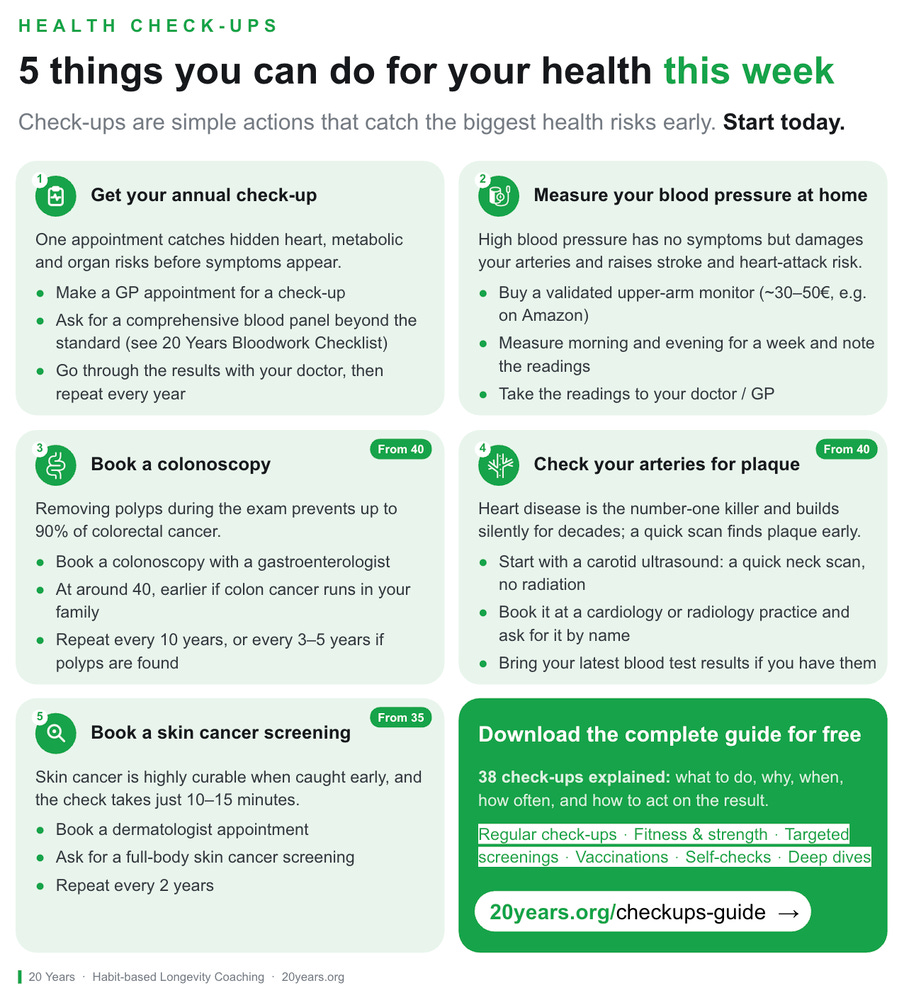
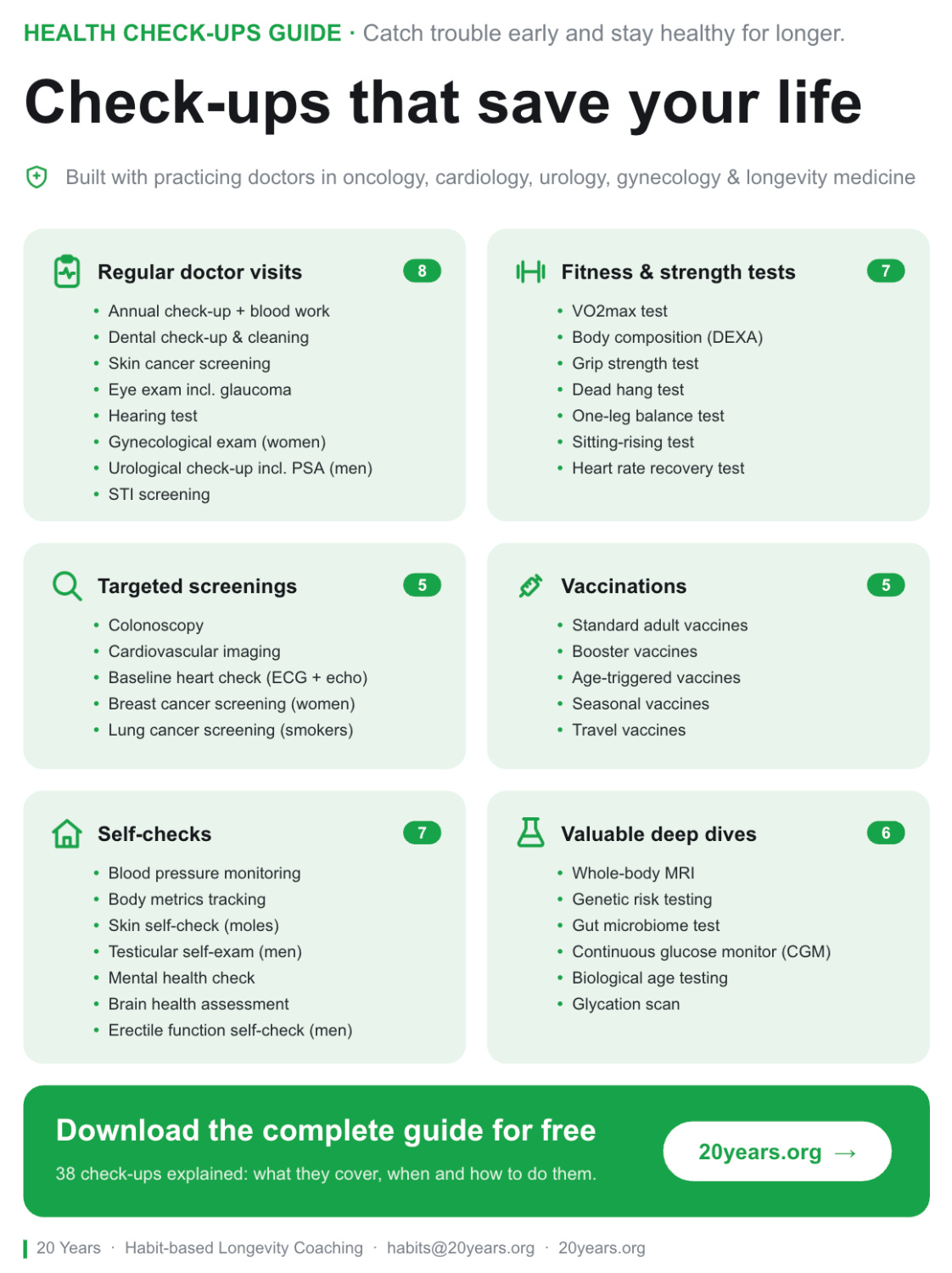
The result is the 20 Years Health Check-ups Guide – a comprehensive, evidence-based overview of every preventive check-up and screening that matters for adults (18+). It covers 37 health tests across six categories:
A. Regular check-ups – the exams you repeat every year or two, covering your blood work, teeth, skin, eyes, ears, and sex-specific health. Together they form the backbone of your prevention. Includes: blood work, dental exams, skin cancer screening, eye and hearing tests, gynaecological and urological exams, and STI screening.
B. Fitness and strength tests – these measure your physical capacity: cardio fitness, strength, balance, and body composition. They’re among the strongest predictors of how long and how well you’ll live, and unlike your genes, you can actively train and improve every one of them. Includes: VO2max, DEXA body composition, and functional strength tests.
C. Targeted screenings – these look for cancer, heart disease, and other serious conditions while they’re still treatable. They run at longer intervals and are triggered by your age or risk factors. Includes: colonoscopy, cardiovascular imaging, breast cancer screening, and lung cancer screening.
D. Vaccinations – most adults carry gaps in their childhood vaccinations, need the occasional booster, and become eligible for new vaccines as they age. Includes: standard vaccines, boosters, age-triggered and seasonal vaccines, and travel vaccines.
E. Self-checks – simple checks you do at home, no appointment and little effort, with high payoff. They help you spot changes early and give your doctor real data to act on. Includes: blood pressure, body metrics, skin self-checks, testicular self-exams, mental health, and brain health.
F. Valuable deep dives – optional tests for people who want a more complete picture. They cost more and are more specialised, and they pay off most when repeated over time to track your personal trends. Includes: genetic risk testing, continuous glucose monitoring, and biological age testing.
For each item, the guideline answers: What is it? Why do it? Who needs it? How to do it? How often? What to do with the result? Plus direct links to book appointments or order tests.
Not every check-up matters equally, and not every test is useful for every person. Age, sex, family history, and lifestyle determine which screenings are relevant for you. The guideline is structured to help you figure that out – with overview tables by age and by frequency, so you can see at a glance what’s due for you right now.
The most important filter: a screening is most valuable when finding something early actually changes the outcome. A colonoscopy that removes a polyp before it becomes cancer? Life-saving. A whole-body MRI that flags a harmless spot and triggers months of scans and worry over something that never needed treating? Potentially more stressful than helpful. Because more testing is not always better, the guideline makes the tradeoffs visible.
Download the full guide for free: 20 Years Check-ups Guideline
This is a work in progress – and I need your help
This guideline has been developed with significant input from practicing doctors, researchers and preventive medicine specialists. But I’m not a doctor myself. And the field is vast.
So I’m sharing this publicly because I want to get it right. If you’re a medical professional or someone who cares about preventive health, I would genuinely appreciate your feedback:
What’s missing? Are there important screenings or tests that should be included?
What’s too much? Are there recommendations that are overly aggressive or not well-supported by evidence?
What’s potentially misleading? Are there areas where the guideline could create more harm than good – for example, by encouraging over-testing?
Is this useful? Does an overview guideline like this, written for laypeople rather than clinicians, actually help people navigate their health better?
I’m especially grateful for input from specialists in specific areas – e.g, oncology, cardiology, endocrinology, mental health, genetics – who can challenge or refine the recommendations in their field.
Download the full Health Check-ups Guideline here → 20years.org/checkups-guide
One more thing: We’re building our Health Check-ups Guide into a free, user-friendly app – a simple tracker that shows you which check-ups are due based on your age, sex and personal risk, reminds you when it’s time, and keeps your results in one place. So you always know where you stand, without digging through PDFs. More on that soon.
If this guideline resonates with you, share it with someone who’s been meaning to book that check-up. It might be the nudge they need.
Malte Bedürftig is the founder of 20 Years, a habit-based longevity coaching company. This article is part of a series on how to navigate health and longevity with evidence and common sen
References
Borsky, A., Zhan, C., Miller, T., et al. (2018): Few Americans receive all high-priority, appropriate clinical preventive services. Health Affairs, 37(6). pubmed.ncbi.nlm.nih.gov/29863918
Gottesman, R.F., Schneider, A.L., Zhou, Y., et al. (2017): Associations between midlife vascular risk factors and 25-year incident dementia in the Atherosclerosis Risk in Communities (ARIC) cohort. JAMA Neurology, 74(10), 1246–1254. pubmed.ncbi.nlm.nih.gov/28783817
Klag, M.J., Whelton, P.K., Randall, B.L., et al. (1996): Blood pressure and end-stage renal disease in men. New England Journal of Medicine, 334(1), 13–18. pubmed.ncbi.nlm.nih.gov/7494564
Lewington, S., Clarke, R., Qizilbash, N., et al. (2002): Age-specific relevance of usual blood pressure to vascular mortality: a meta-analysis of individual data for one million adults in 61 prospective studies. Lancet, 360(9349), 1903–1913. pubmed.ncbi.nlm.nih.gov/12493255
National Cancer Institute: SEER Cancer Stat Facts: Female Breast Cancer; Melanoma of the Skin. seer.cancer.gov/statfacts/html/breast.html · seer.cancer.gov/statfacts/html/melan.html
O’Donnell, M.J., Xavier, D., Liu, L., et al. (2010): Risk factors for ischaemic and intracerebral haemorrhagic stroke in 22 countries (INTERSTROKE): a case-control study. Lancet, 376(9735), 112–123. pubmed.ncbi.nlm.nih.gov/20561675
Public Health England (2019): NHS Health Check programme. gov.uk/government/collections/nhs-health-check-programme
Starker, A., Saß, A.C. (2013): Inanspruchnahme von Krebsfrüherkennungsuntersuchungen: Ergebnisse der Studie zur Gesundheit Erwachsener in Deutschland (DEGS1). Bundesgesundheitsblatt, 56(5–6), 858–867. doi.org/10.1007/s00103-012-1655-4
United States Renal Data System (2023): Annual Data Report: Epidemiology of Kidney Disease in the United States. usrds-adr.niddk.nih.gov
Zauber, A.G., Winawer, S.J., O’Brien, M.J., et al. (2012): Colonoscopic polypectomy and long-term prevention of colorectal-cancer deaths. New England Journal of Medicine, 366(8), 687–696. pubmed.ncbi.nlm.nih.gov/22356322