

Do you know the pleasure of putting things in boxes? Almost as good as finishing stuff (I’m talking milk cartons) and throwing away stuff.
A few weeks ago I took my kitchen apart. The drawers had reached the state that every kitchen drawer eventually reaches: baking ingredients next to supplements, next to snacks, next to a spice mix bought for exactly one recipe. Some things had given up on the drawer entirely and were living on the counter. There was more stuff than space.
Summoning my organizational spirits (who only surface on special days), I bought a stack of glass jars and a set of transparent boxes. Instead of just cleaning, I asked myself one question: what do I want to see first when I open this?
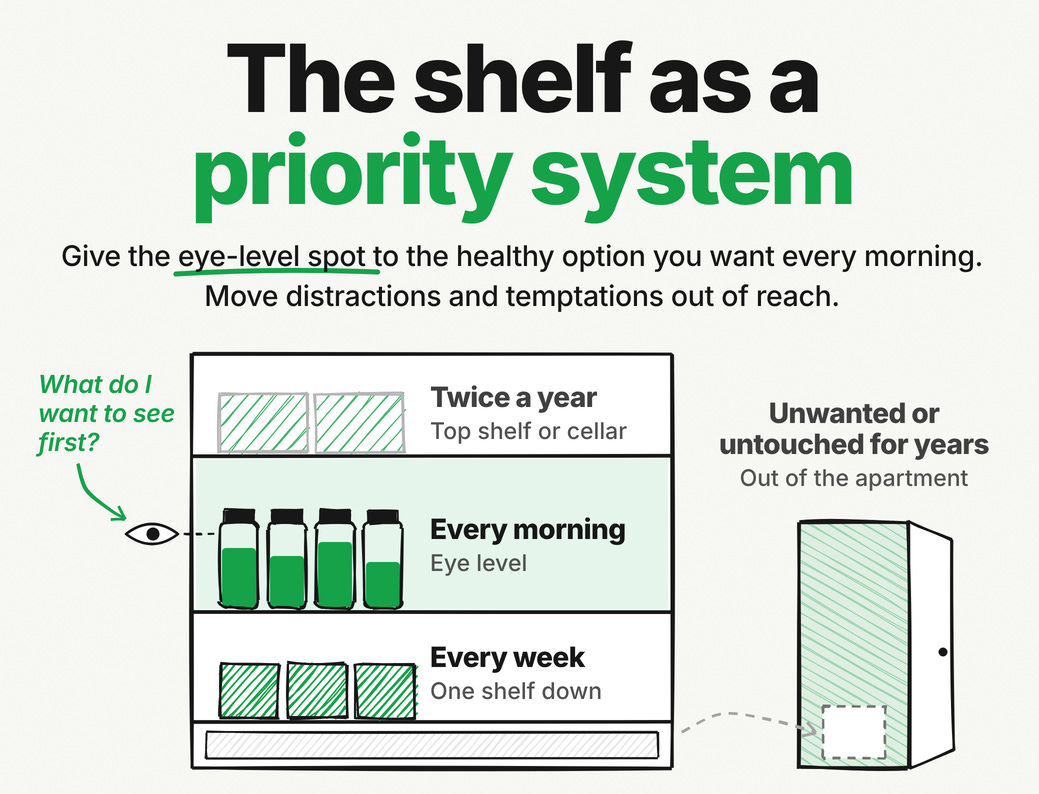
The answer turned out to be breakfast. Walnuts in one jar, flax seeds in another, then protein powder, creatine, everything that goes into my muesli in the morning, all of it at eye level. Behind that, on the shelf that used to be the final resting place for everything that had no home, three boxes: one for supplements, one for staples, and cooking utensils at the bottom. Then I did the same to the fridge, where a few boxes now hold prepared food, so the healthy option is also the fastest one. A few things did not survive the afternoon, including a cheese grater I have never once used.
It took two hours. The feeling afterwards was out of all proportion to the task.
The good feeling after the mess is gone
When I open the cupboard the next morning, everything is where it should be, and something in my head goes quiet. I can reach any part of the shelf without thinking first. Nothing is lying around anymore that does not sit with things of its own kind, under something like a title – like the box full of small boxes (no joke: it exists!). The shelf has become predictable. I am back in control!
I should admit the trigger, though. Part of it was procrastination, and part of it was that I felt overwhelmed by things that had nothing to do with the kitchen, including the health project I run for a living. Too many open questions, too many things to keep an eye on. A shelf was something I could actually finish.
What the pile costs you
Why does a sorted shelf feel so much better than a messy one, when the contents are identical?
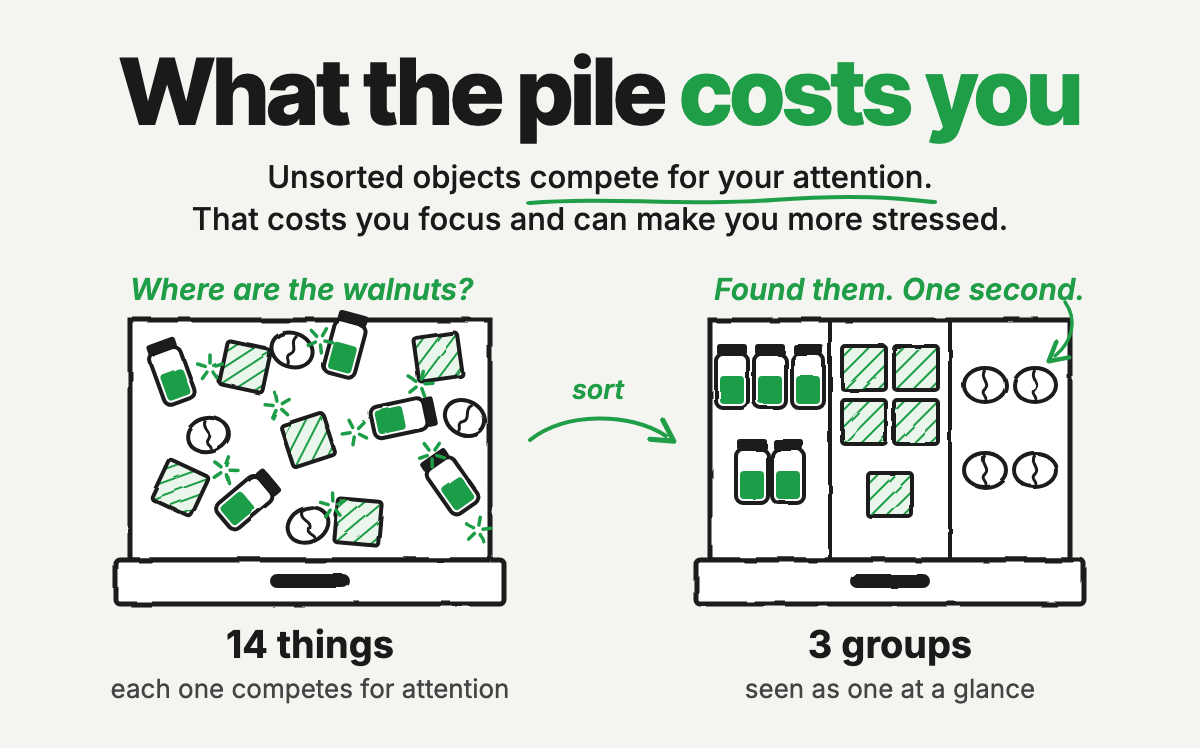
Your visual system does not treat a pile as one thing. Objects that show up together in your field of view compete with each other, and each one dampens the others. Attention has to step in and settle the conflict. When the objects already form an obvious group, the brain does most of that work by itself and attention has almost nothing left to do (McMains & Kastner, 2011). So a drawer with fourteen unrelated items charges you a small attention fee every time you open it. A drawer with three clear groups comes for free.
The effect shows up in the body. Researchers recorded 30 working couples giving a tour of their own homes. Among the women, the more someone talked about mess, piles and unfinished projects, the flatter her cortisol ran across the day and the lower her mood sat by evening (Saxbe & Repetti, 2010). Normally, cortisol is high in the morning and drops toward night. Across 80 studies, a flatter curve is associated with poorer mental and physical health (Adam et al., 2017).
The anthropologist Mary Douglas got there without any cortisol samples. Dirt, she wrote, is matter out of place (Douglas, 1966). Walnuts in a jar are a superfood. Walnuts in the drawer with the batteries and the birthday candles are a problem.
What a box does
Humans have been chewing on this for a while. Aristotle gave an entire early work, the Categories, to the question of what kinds of things there are. It follows a practical observation: We do not deal with the world one object at a time, we deal with it in kinds.
Eleanor Rosch called this cognitive economy: a category system should give you the most information for the least mental effort (Rosch, 1978). Once walnuts, flax seeds and oats have become the muesli group, you are no longer holding three things in your head. You hold one, and you unpack it when you need it.
That is what a box does that a neat pile cannot. A box has edges – and an edge is a decision: this belongs, that does not. It also has a name. I did not write a single label, by the way (even though a label maker makes a cool Christmas present for people like me – just saying, dear spouse). Glass and clear plastic do the same job faster, because you do not have to read anything. Opening that cupboard is now an act of recognition, and it takes about a second.
From a shelf to a system
One box helps. The system starts when the boxes start talking to each other.
What you use every morning sits at eye level. What you use weekly moves one shelf down. What you use twice a year goes somewhere else entirely, and what you have not touched in years should not be in the room (or in your apartment) at all. What makes this a system is the distance between the boxes. Once it is set up, the shelf does your prioritizing for you, without asking you again.
I ran the same operation on my health data, and that one mattered more than the kitchen. Check-up results, blood work, blood pressure readings, vaccinations, supplements with doses, training plans. All of it existed, spread across six devices, apps and paper notes, and I could not have told you where any single item was. Now it is one folder with a handful of subfolders. Same information, and I can find any of it in ten seconds.
Why does this work on things you cannot touch?
The bottleneck is the same one: attention. Psychologists call the fix cognitive offloading. Instead of carrying information around in your head, you park it somewhere in the world (Risko & Gilbert, 2016). A shopping list does this, so does a calendar entry, so does a photo of where you parked the car. Each one is a small box outside your brain. As David Allen put it: “Your mind is for having ideas, not holding them.”
Open goals stay active in the mind and interfere with whatever you try to do next, which is why the unanswered email keeps tapping you on the shoulder while you are trying to think. A study tested this on students. One group listed two important errands they still had to run. A second group listed the same kind of errands and then wrote down exactly how, when and where they would handle each one. A third group had nothing open to think about. Everyone then read the opening pages of a detective novel. The first group kept drifting back to their errands and understood less of what they read. The planners read as well as the third group (Masicampo & Baumeister, 2011).
What the planners did has a name: Psychologists call it an implementation intention – you fix in advance when, where and how you will act. Across 94 studies, that had a medium-to-large effect on whether people reached their goals (Gollwitzer & Sheeran, 2006).
A plan is a box. You put the thing inside, write when and where on the outside, and your head lets go of it. Even a plain list helps at bedtime. Researchers gave 57 students one of two writing tasks before lights out: a list of everything they had to do the next day, or a list of what they had already done. The to-do list group fell asleep 9 minutes faster, and the more detailed the list, the faster they dropped off (Scullin et al., 2018). I tried it, and it works embarrassingly well: far fewer forgot-something dreams, far fewer bolt-upright moments in the dark.
Where boxes fail
Putting your whole life in boxes is not the goal, and it would be a miserable outcome if you managed it. The goal is to box the utensils, meaning the recurring, unglamorous parts of daily life, so that they stop asking for your attention. Everything that makes life worth living stays unsorted.
From my own experience, there are at least two ways this goes wrong:
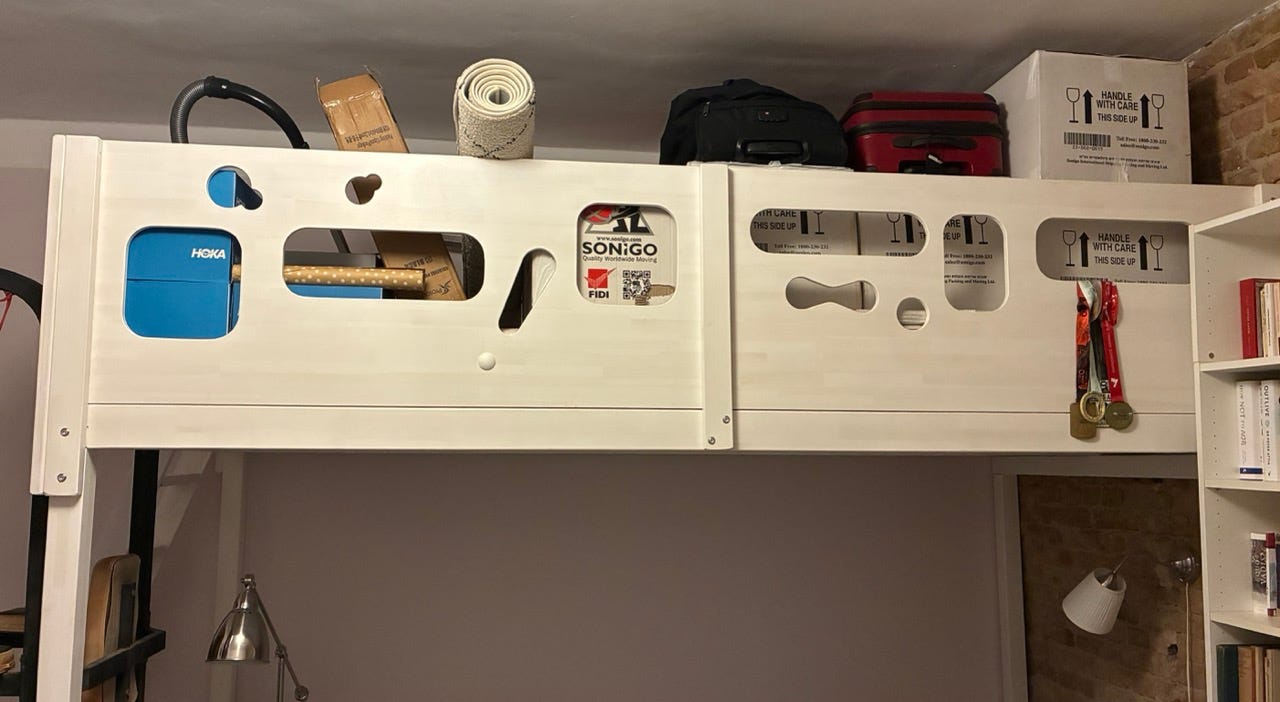
The graveyard box: Above my bed there is a raised bunk that nobody sleeps in, and it has become the place where things go to be kept rather than used. Some of it earns its place. My winter running kit is useless for eight months and essential in January. The rest are graveyard boxes: clothes I have not worn in two years, things I keep because they might be useful one day. A box you never open is just deferral in better packaging. My rule now: if it is not seasonal and I have not used it in six months, another year will not change that. If you really want to get rid of stuff, don’t listen to me. Talk to my co-founder Tom, who is an obsessive minimalist.
Sorting instead of doing: See my kitchen afternoon. Organizing produces a strong sense of progress, which is what makes it such an effective substitute for progress. If you are refining the system more often than you are using it, the system has become the task.
Habits are behavior boxes
A habit is a bundle of behaviors that your brain has packed into one unit. A routine is a bigger bundle: five or six behaviors that always come in the same order, in the same place.
You drive a familiar route and arrive without recalling a single turn. You brush your teeth without going through eleven steps. Once a sequence is learned, your brain checks the start and the finish and lets everything in between run unsupervised. Animal studies show the same shape: in rats running a route they had learned, the cells that store routines fired hard at the entry and at the exit, and much less along the way (Jog et al., 1999; Graybiel, 2008).
A box has an edge and a name, so you stop dealing separately with the fourteen items inside. A routine has a beginning and an end, so you stop deciding your way through it.
That is also why habit stacking works. Coffee, then vitamins, then ten minutes of stretching, in that order every morning, stop being three decisions after a few weeks. They turn into one box with “morning routine” on the lid.
Most of us never packed these boxes on purpose. When researchers had people log what they did through the day, 43 percent of it was something they did just about every day, in the same place (Wood, Quinn & Kashy, 2002). So nearly half your day is already habit – but many of these habits you never chose. Which is the opening: you can look at what is in those boxes, drop what costs you, and make the ones you want easier to reach.
Easier almost always means the environment. Back to the kitchen: A kitchen is more than storage. It is the room where you make the same food decisions every day of your life. When I put the walnuts and the flax seeds at eye level and the prepared food at the front of the fridge, I was organizing my nutrition habits as much as the shelves. Discipline is a poor substitute for a well-placed jar.
The freedom on the other side
Order and freedom sound like opposites. Boxes, labels, routines, systems, all of that belongs to the vocabulary of a narrow life. Creativity is supposed to live in the mess. I hear a version of this whenever habits come up: “I don’t want to live on a schedule. I don’t want to become boring and predictable.”
I used to be 100% this person: I liked to see myself as the master of creative chaos. Partly because habits and a structured life never came to me naturally. Partly because success looks so much cooler when it appears out of nowhere like a divine incarnation of genius rather than the result of meticulous planning (which is about as cool as a PowerPoint by a business consultant).
It took many years for me to admit that this bohemian drift did not enhance my creativity but limited it. The daily trivialities that no Sartre or van Gogh can live without kept competing with the thinking I cared about. These mundane tasks had no place of their own, so they jumped around freely and cried for attention at the worst possible moment.
I also realized that the danger of planning my life away is only real if I box the wrong things. The right ones are the boring practical stuff my artsy heart despises and my rational self requires: exercise, food, sleep and the check-ups I keep postponing. They should run on as little time and as few decisions as possible, because they have to happen anyway. Handle them well and they stop showing up as open questions in your head. What comes back to you is time, and more importantly attention.
I use this newly gained mental space for the things that are most important to me: creative writing, demanding work that makes a difference, long conversations, the people close to me, and the joy of thinking a thought all the way through. Most of all, it makes room for the things that do not fit in any box: adventure, chance encounters, serendipity. My best days (and probably yours, too) are the unplanned ones: I won’t forget when I spontaneously hopped on a bus in Stockholm that drove me to a mysterious art venue built into a lake’s rocky shoreline. Or when a morning jog in Crete turned into a summit adventure in a thunderstorm.
Structure is what buys me those days of unedited (self-)discovery. My last trail adventure, 105 kilometers and 20 hours through the night, only happened because months of unremarkable training runs happened first. The adventure needs the routine underneath it, and the routine turns joyless without something worth spending it on.
So sort the shelf. Sort the health folder, and the four or five things that ask you the same question every week. Then stop. Because life is what happens outside the box.

At 20 Years, we help people build these habit systems across the dimensions that decide how long you stay healthy: exercise, nutrition, sleep, mental health and prevention. The Healthspan Booster is the compact version: four modules at your own pace, a weekly 1:1 with a coach, and a weekly live case clinic in a group of no more than eight. It starts in January 2027.
Malte Bedürftig is the founder of 20 Years, a habit-based health coaching company.
References
Peer-reviewed journal articles
Adam, E. K., Quinn, M. E., Tavernier, R., McQuillan, M. T., Dahlke, K. A. & Gilbert, K. E. (2017): Diurnal cortisol slopes and mental and physical health outcomes: a systematic review and meta-analysis. Psychoneuroendocrinology, 83, 25-41. https://doi.org/10.1016/j.psyneuen.2017.05.018
Gollwitzer, P. M. & Sheeran, P. (2006): Implementation intentions and goal achievement: a meta-analysis of effects and processes. Advances in Experimental Social Psychology, 38, 69-119. https://doi.org/10.1016/S0065-2601(06)38002-1
Graybiel, A. M. (2008): Habits, rituals, and the evaluative brain. Annual Review of Neuroscience, 31, 359-387. https://doi.org/10.1146/annurev.neuro.29.051605.112851
Jog, M. S., Kubota, Y., Connolly, C. I., Hillegaart, V. & Graybiel, A. M. (1999): Building neural representations of habits. Science, 286(5445), 1745-1749. https://doi.org/10.1126/science.286.5445.1745
Masicampo, E. J. & Baumeister, R. F. (2011): Consider it done! Plan making can eliminate the cognitive effects of unfulfilled goals. Journal of Personality and Social Psychology, 101(4), 667-683. https://doi.org/10.1037/a0024192
McMains, S. & Kastner, S. (2011): Interactions of top-down and bottom-up mechanisms in human visual cortex. Journal of Neuroscience, 31(2), 587-597. https://doi.org/10.1523/JNEUROSCI.3766-10.2011
Risko, E. F. & Gilbert, S. J. (2016): Cognitive offloading. Trends in Cognitive Sciences, 20(9), 676-688. https://doi.org/10.1016/j.tics.2016.07.002
Saxbe, D. E. & Repetti, R. L. (2010): No place like home: home tours correlate with daily patterns of mood and cortisol. Personality and Social Psychology Bulletin, 36(1), 71-81. https://doi.org/10.1177/0146167209352864
Scullin, M. K., Krueger, M. L., Ballard, H. K., Pruett, N. & Bliwise, D. L. (2018): The effects of bedtime writing on difficulty falling asleep: a polysomnographic study comparing to-do lists and completed activity lists. Journal of Experimental Psychology: General, 147(1), 139-146. https://doi.org/10.1037/xge0000374
Wood, W., Quinn, J. M. & Kashy, D. A. (2002): Habits in everyday life: thought, emotion, and action. Journal of Personality and Social Psychology, 83(6), 1281-1297. https://doi.org/10.1037/0022-3514.83.6.1281
Books
Allen, D. (2001): Getting Things Done: The Art of Stress-Free Productivity. Penguin.
Aristotle: Categories. In J. Barnes (Ed.), The Complete Works of Aristotle. Princeton University Press, 1984.
Douglas, M. (1966): Purity and Danger: An Analysis of Concepts of Pollution and Taboo. Routledge.
Rosch, E. (1978): Principles of categorization. In E. Rosch & B. B. Lloyd (Eds.), Cognition and Categorization (pp. 27-48). Lawrence Erlbaum.